MLB Desk · Article 032 · By Cash Emerson Roper · November 4, 2026 · 9:35 AM ET
Once Every 40 Years Is Not Enough
Start with the World Series, because it explains the whole fight. Milwaukee won it with the 19th-highest payroll in baseball. Tampa Bay lost it with the 25th. The commissioner looked at that and said the system is broken. The players looked at the same five games and said the system works. On Tuesday the owners offered to delay their salary cap by a year, and the players rejected it the same day. The current deal expires December 1.
The confetti was still on the Tropicana Field carpet when the argument started.
Milwaukee beat Tampa Bay in five games, and the facts were beautiful enough to end any debate. The Brewers carried the 19th-highest payroll in baseball on USA TODAY's final accounting, $143.5 million; the Rays the 25th, $98.3 million. It was the first World Series since 1991 between two bottom-half payroll teams, Milwaukee's first championship, and Tampa Bay's third pennant — 98 wins, the best record in the American League — ending in a third October heartbreak.
Rob Manfred looked at that Series and saw a malfunction. "Once every 40 years is not enough," he said. Bruce Meyer looked at the same five games and saw a system doing exactly what it promised.
Baseball just crowned its most unlikely champion in a generation. Its next act is to lock the gates.
The bargaining agreement expires December 1 at 11:59 p.m. Eastern. A lockout is expected December 2, and neither side will extend the old deal. The owners blinked on timing this week; the players answered in writing: a delayed cap is still a cap. The fight is over whether baseball's system — the last uncapped one in major North American sports — survives at all.
If you are just arriving: a lockout is not a strike. Players walk out in a strike; in a lockout, owners lock the doors — no signings, no trades, no facilities — in winter, on purpose, so players cannot threaten a September walkout.
The Offer That Lasted One Day
On Tuesday, November 3, MLB proposed pushing its hard cap and salary floor back a year, from 2027 to 2028, at a projected $258.2 million cap and $180.2 million floor. 2027 would run as a transition year under the current luxury-tax system, at 2026 thresholds (base $244 million).
The MLBPA rejected it the same day. "Despite MLB's proposal to delay implementation to 2028," the union's statement read, "at its core, the negative impacts of the owners' salary cap remain the same." The statement accused the owners of building "one designed to line their pockets and increase their franchise values," and charged a $400 million cut to amateur signing bonuses. The owners moved the date. They did not move the demand. The union noticed within hours.
What the Owners Actually Want
Strip away the dates and this is the most aggressive restructuring of baseball economics since 1994: a 50–50 split of defined baseball revenue, and a hard ceiling and hard floor where today there is only a luxury tax — a tax the richest clubs simply pay (the Dodgers' all-in cost ran past $500 million this year, payroll plus tax, per ESPN). A hard cap is a wall no checkbook climbs.
They also want an escrow. Salaries would be partly held back, and if the players' share of defined revenue topped 50 percent, the excess would be clawed back — the mechanism behind the union's charge of the "elimination of fundamental player rights, including guaranteed contracts." A guaranteed contract with a clawback is a promise with an asterisk.
Every sweetener comes with the same condition: accept the cap. The minimum salary for players with two-plus years of service rises to $1 million, up from $780,000. Players 30 and older could reach free agency after five years instead of six — but his club could keep him for the sixth year at a qualifying-offer salary, and if he refuses, he goes to arbitration, not free agency. For everyone else, the qualifying offer disappears.
Manfred's case rests on two claims. Over two decades of data, he says, larger markets hold a "very statistically significant advantage" in making the playoffs and going deep in them. And ownership, in his words, shows an "unprecedented level of unanimity" that a cap has to happen. We note, as Tampa fans, that unanimity is a lovely word for thirty billionaires agreeing the problem is the payroll in Milwaukee.
What the Union Is Really Defending
The union has refused a cap for more than 30 years. That refusal is not a posture; it is a founding memory, and 1994 is why. The last time owners formally demanded a cap, the players struck on August 12, 1994; the World Series was cancelled for the first time since 1904; 948 games were lost. The owners imposed their cap anyway; Judge Sonia Sotomayor's injunction restored the old system, and the strike ended after 232 days.
Bruce Meyer, the union's interim executive director and its chief negotiator in the 2021–22 fight, speaks that lineage. In June he called a cap "a form of institutionalized collusion." In October he called it a "nuclear bomb." On MLB's own revenue definitions, he said, the plan would have cost players more than half a billion dollars in 2026 alone. "The salary cap is the opposite of competition," Meyer said. "The salary cap tells teams you can't compete too much." And, pointedly: "There's no reason whatsoever that the Pirates can't do what the Brewers have done or what the Rays have done. None whatsoever, right?"
The union wants a bigger version of the current world. Its minimum salary starts at $1.5 million and rises to $2.2 million by 2031. Its luxury-tax base jumps to $300 million in 2027. And instead of a hard floor, it proposes a "Competitive Integrity Tax" on clubs that refuse to spend — plus a guarantee of at least $240 million in annual revenue for every small-market club. Force the cheap owners to spend. Just never tell the rich ones they can't.
How This Fight Compares
The history has a pattern, and it is not subtle. The three longest stoppages in modern North American sports were all fought over a cap — imposing one, or tightening one. Fights after a cap already existed were about splitting money, and ended with the system intact and most of the season saved.
| Stoppage | Was a cap the fight? | Days | Games lost | How it ended |
|---|---|---|---|---|
| NHL lockout, 2004–05 | Yes — owners demanded one | 310 | 1,230 (season cancelled) | Owners got their cap |
| MLB strike, 1994–95 | Yes — owners demanded one | 232 | 948 | No cap; a federal injunction restored the old system |
| NBA lockout, 1998–99 | Cap system + max salaries | 204 | 464 | Soft cap kept; first individual salary maximums |
| NBA lockout, 2011 | Owners demanded a hard cap | 161 | 240 (16 per team) | No hard cap; revenue split moved to about 50–50 |
| NFL lockout, 2011 | No — split + rookie scale; cap existed | 136 | 0 | Cap kept; rookie wage scale added |
| NHL lockout, 2012–13 | No — revenue split; cap existed | 113 | 510 | 50–50 split; cap stayed |
| MLB lockout, 2021–22 | No cap demand | 99 | 0 | Full 162-game season played |
| NFL strike, 1987 | No — free agency; no cap existed | 24 | 14 (one week; replacements played three) | Players returned without a deal |
| MLB, 2026–27 | Owners demanding a cap | — | Pending | CBA expires Dec. 1, 2026 |
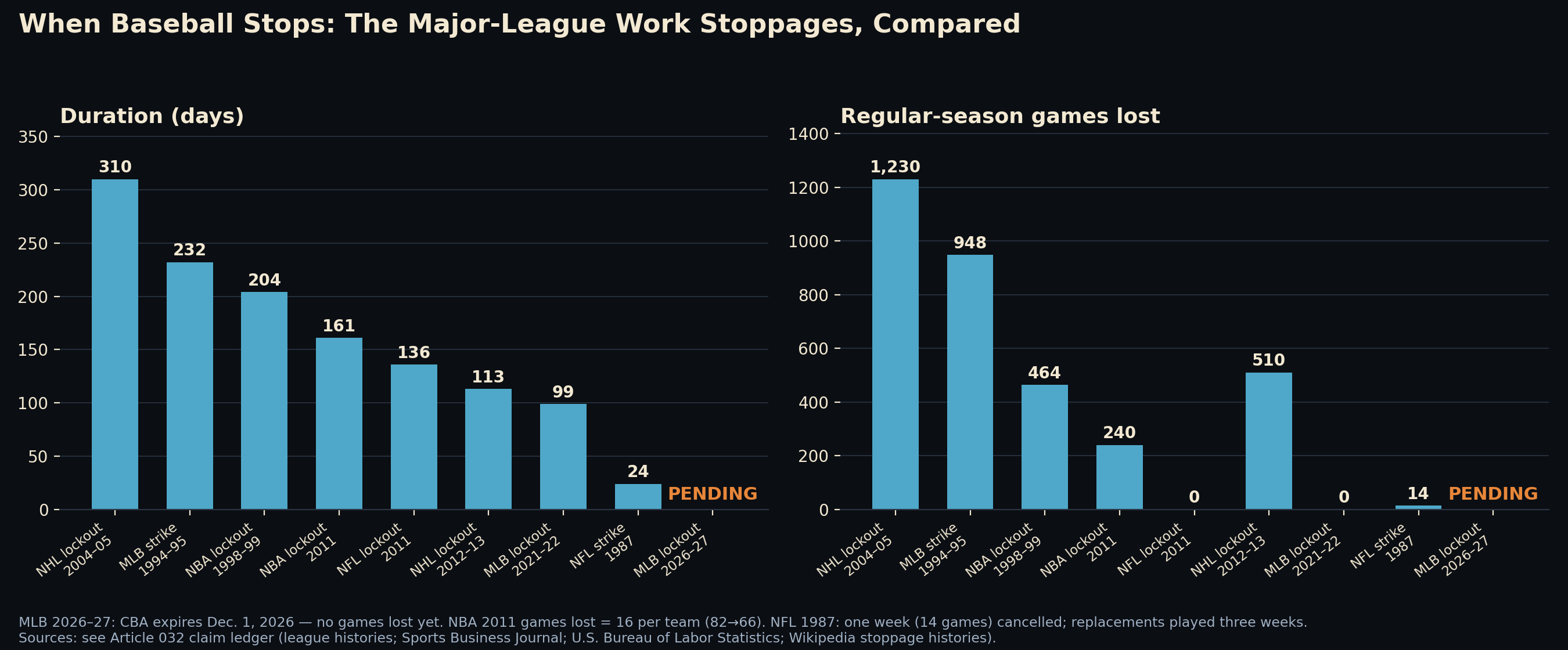
Read it the way the players read it: cap fights produce cancelled World Series and cancelled seasons. Money fights produce shortened seasons. This winter's fight is the first kind.
The Math, and the Trophy Both Sides Are Holding
The spread is the owners' Exhibit A. The Mets spent $346.8 million and missed the playoffs entirely. The Guardians spent $74.2 million, the lowest — a spread of $272.6 million, the top spending 4.7 times the bottom.
The union's Exhibit A is the same spreadsheet read aloud. The Dodgers were swept by Milwaukee in the NLCS. The Guardians reached the ALCS. And the trophy sits in Milwaukee, with Mark Attanasio — a cap supporter on the league's labour committee.
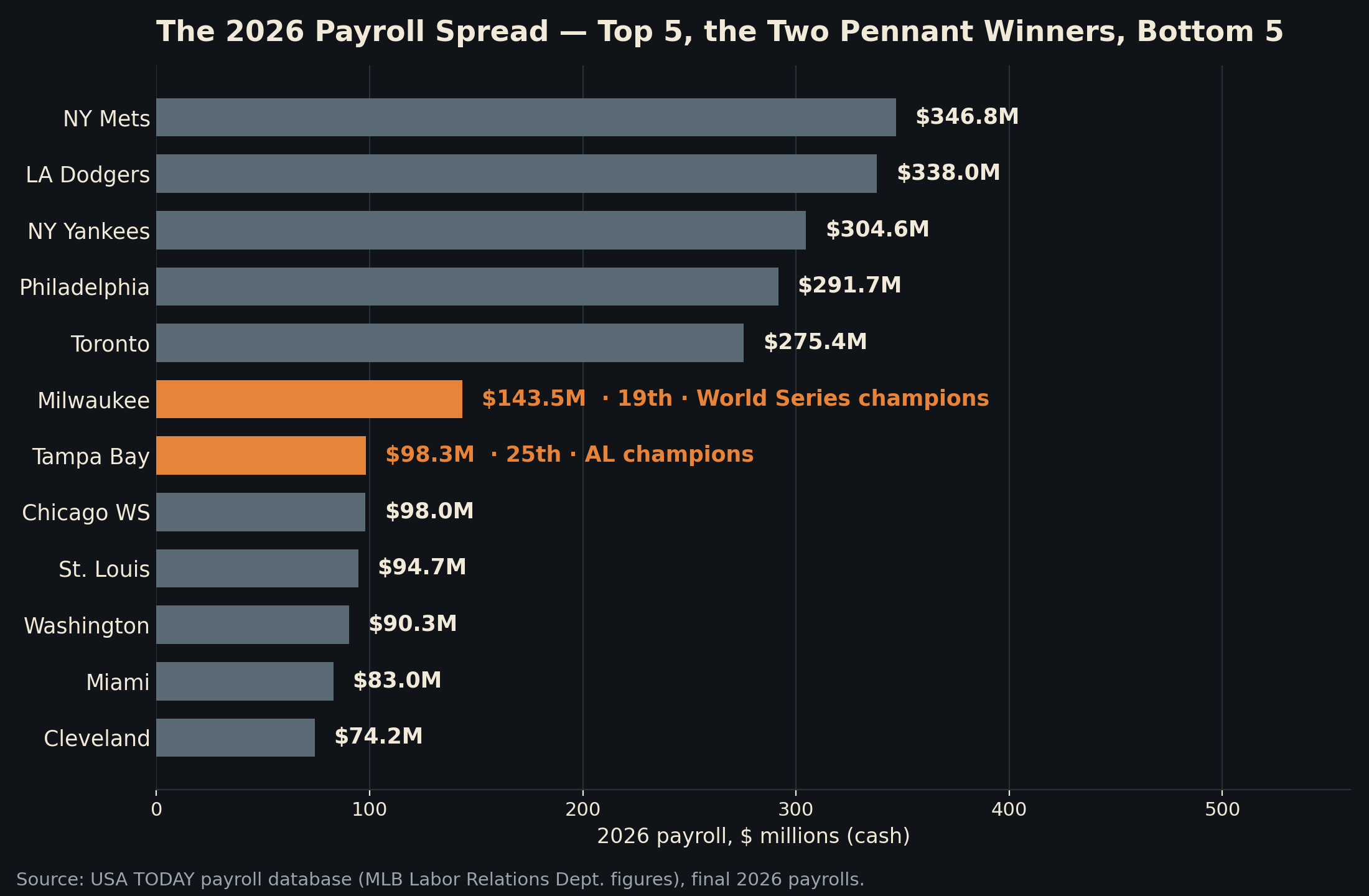
On the league's own arithmetic, twelve clubs must add a combined $636 million to reach the floor and eight must cut a combined $528 million to fit under the cap — net, plus $108 million. Two-thirds of the sport would have to change its behavior on command. One caveat: rankings move with methodology — other ledgers place the Rays anywhere from 26th to 28th. The spread is real in every accounting.
The Rays Are the Test Case
No team sits closer to the center of this fight, and none has said less. Let the record be precise: no Rays official has commented on the cap proposal in any reporting we could find, and we will not invent a position for the club.
Patrick Zalupski's group bought the Rays for a reported $1.7 billion, a sale that closed September 30, 2025. A $2.3 billion development with a 31,000-seat ballpark is approved for Opening Day 2029. And Zalupski has said where this payroll belongs once the park opens: top 15, "maybe even top 10." "Tampa's the No. 11 media market in the country, with 3½ million residents," he said. "There's nothing holding it back."
Top 15 today is roughly $180 million — almost exactly the proposed $180.2 million floor. Zalupski wants to arrive there on ballpark revenue in 2029; the proposal orders him there a year early, by rule.
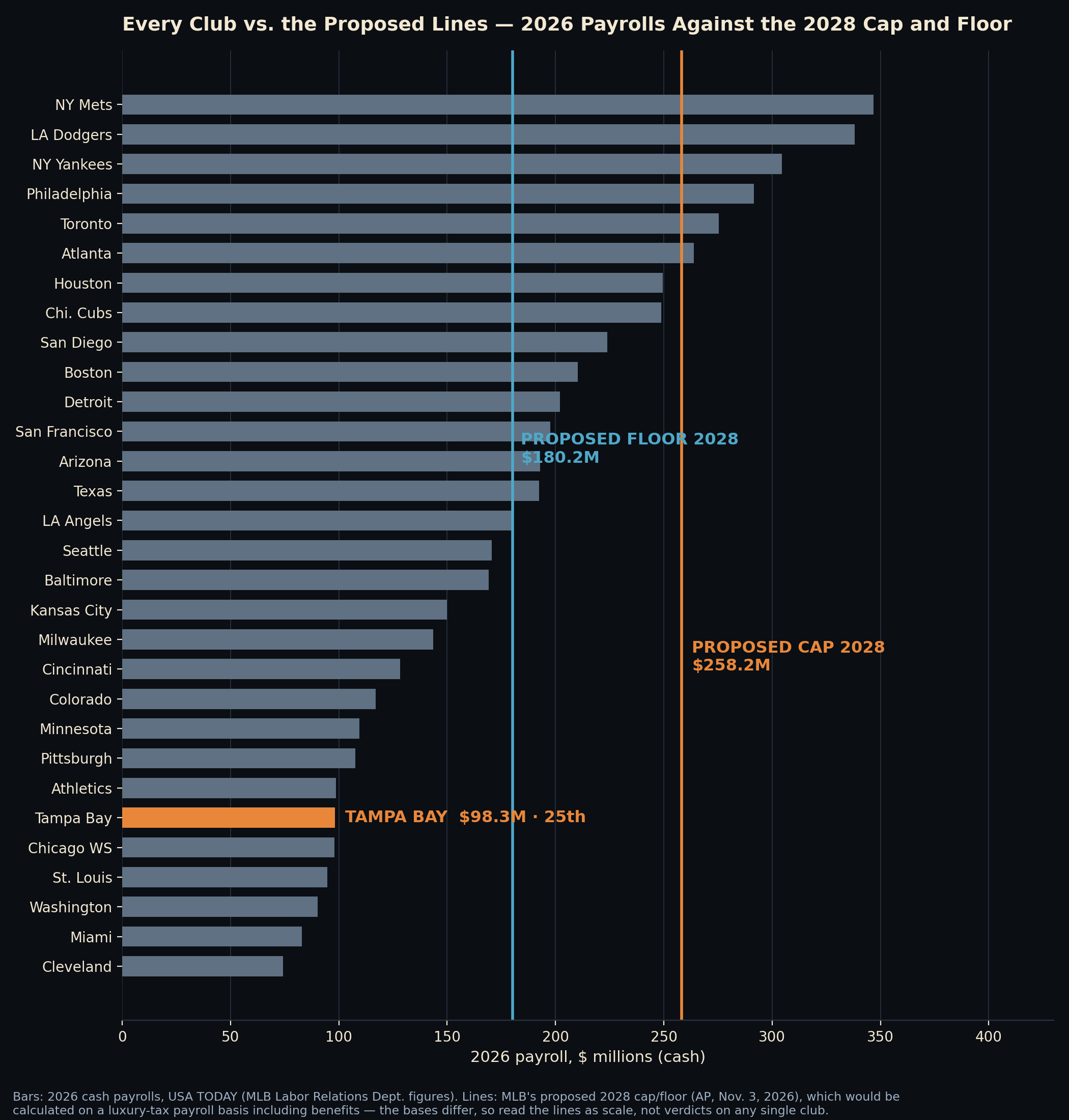
It is not close today. On a tax basis the Rays' payroll is about $116 million — roughly $64 million short of the full floor and about $46 million short of even its 90-percent soft first-year level. And only $25.5 million in guaranteed money sits on the 2027 books: the most flexibility in the sport and the most floor exposure, at once. A franchise that built a pennant winner out of coupons is being told thrift is now a compliance problem.
The Calendar of Pain
December 1, 11:59 p.m.: the agreement expires. December 2: the expected lockout. Before the cliff: qualifying offers come due November 17 at $23.15 million, and free agency has been open since November 2.
If the doors stay closed: spring games begin February 19, Opening Night is March 24, Opening Day March 25. The 2021–22 lockout lasted 99 days, lost no games, and was not about a cap. This one is. Jeff Passan says baseball will be played in 2027 — "When will we see baseball? That's a question that I don't have the answer to." Bob Nightengale reports a growing number of executives expect a start around Memorial Day weekend.
Memorial Day matters because of the coldest number in the fight: at 60 lost games, players miss roughly four paychecks, and MLB's national TV contracts auto-extend through 2029, delaying the owners' next payday. ESPN's backstop follows: games must start around June, so a deal by the start of May at the absolute latest. Everything before that date is theater. Everything after it costs the owners money they cannot recover.
The People Who Actually Pay
Strip this to the studs. The owners want cost certainty and franchise value, and have chosen this winter — after a dream World Series, with a unified room — to retake the fight they lost in 1995. The players want the last uncapped market in American sports to stay uncapped, and can afford the defense.
The fans cannot. A fan's currency is summers. There are only so many, and none are refundable.
We watched a $98 million team with a new owner and a repaired roof win 98 games and a pennant, and a $143 million team lift the trophy. The product has never argued its own case better. Now owners and players will spend the winter arguing whether that October was the system's triumph or its last lucky accident.
Baseball will be played in 2027, the insiders say. The question is how much of it. If the cap survives the winter, the sport that returns will not be the one that just gave us Milwaukee and Tampa Bay. It will be a sport where an October like that is scheduled, budgeted and permitted — a sport like every other league. Once every forty years, it turns out, was not the problem. It was the whole point.