
MLB Desk · World Series · Article 011 · By Cash Emerson Roper · October 27, 2026 · 2:18 PM ET
One Big Inning
No team has ever climbed out of 0–3 in a World Series. History says the grave is real. History also keeps a file of the dead who got up — and the 2026 Tampa Bay Rays match the file in ways no buried team should.
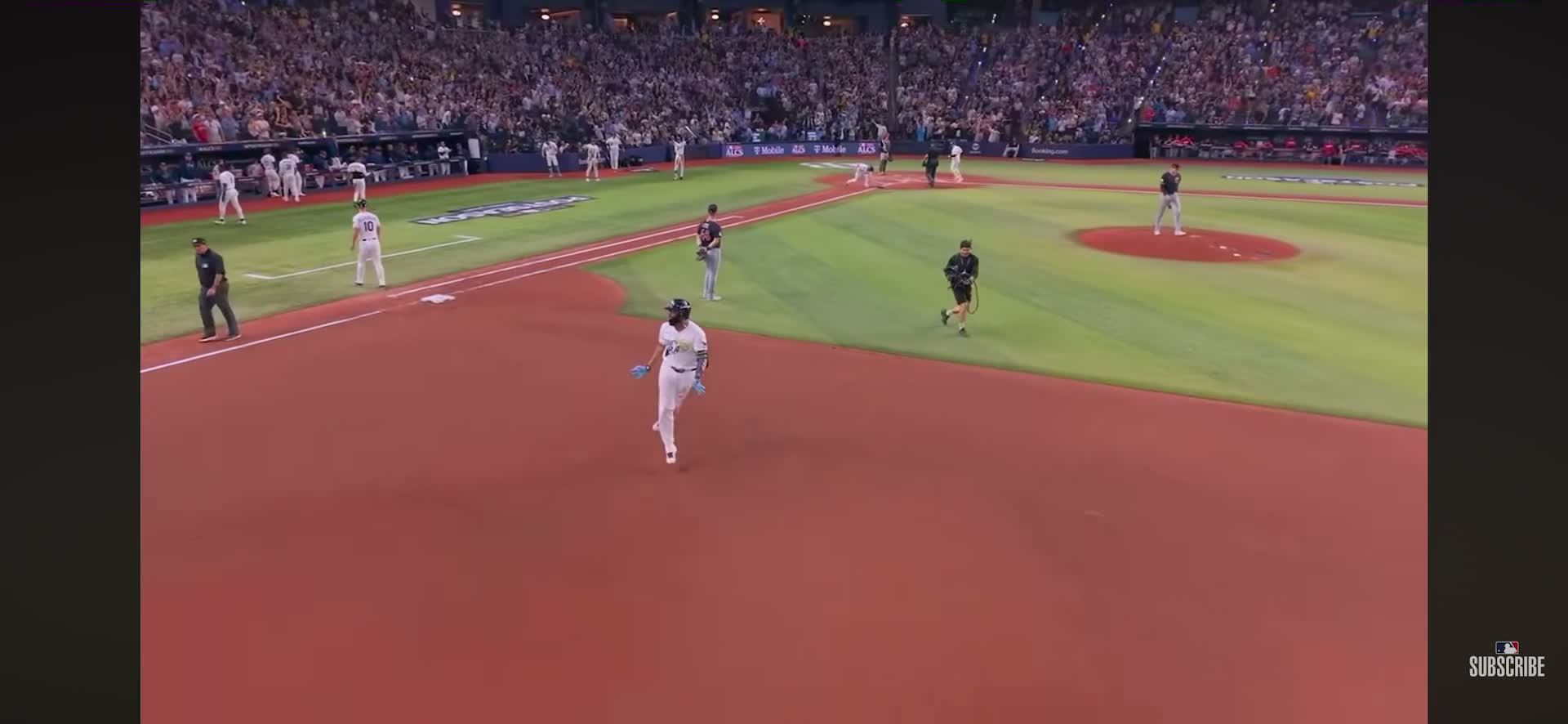
ST. PETERSBURG — There is a sound a season makes when it ends, and in the fifth inning on Monday night, Tropicana Field heard it.
Two outs. That is the part that will live in Tampa Bay's winter if this goes the way everyone expects — not the eight runs, not the 10–1 final, but the two outs. The Rays were two outs into the fifth inning, Freddy Peralta dueling his old team pitch for pitch, when William Contreras rolled a grounder to Junior Caminero at third. Caminero had an out at first. He chose the harder one at second. The throw beat nobody, replay wiped away the out that was called, the bases filled, and then the inning simply would not end. Peralta came out. Cam Booser came in and faced four hitters and retired none of them. When the fifth finally closed, Milwaukee had scored eight runs — every single one of them with two outs, a thing no team had ever done in a World Series inning — and the Brewers walked off the field three games from a coronation and nine innings from a parade.
Kevin Cash defended his third baseman afterward. Of course he did. It is what he has done in this town for a dozen years. But the manager's other line from Monday night is the one Tampa Bay carried home into the Gulf dark: a chip and a chair. Poker language. The language of a man who knows the math and sits down at the table anyway.
So let us do the math, because nobody else in America is going to do it kindly.
All 25 teams that have ever led a World Series three games to none have won it. Twenty-five for twenty-five. No club has climbed out of 0–3 on this stage — not once, not for anybody's dynasty. In the whole of baseball's best-of-seven history, 44 teams have fallen behind 0–3, and 43 of them died there. One lived. That is the wall Tampa Bay is staring at tonight, and any honest case for the Rays has to start by admitting the wall is real.
Here is the other admission, though, the one the obituaries keep skipping: the one team that lived is not an argument against the Rays. It is the blueprint for them. Because when you open the file of sport's impossible comebacks — the whole canon of the dead who got up — a pattern emerges that has nothing to do with magic. Every one of them had the same three things. A way to make the other team stop scoring. A way to score in bunches when the bunching mattered. And somebody in charge who had already survived chaos and did not flinch inside it.
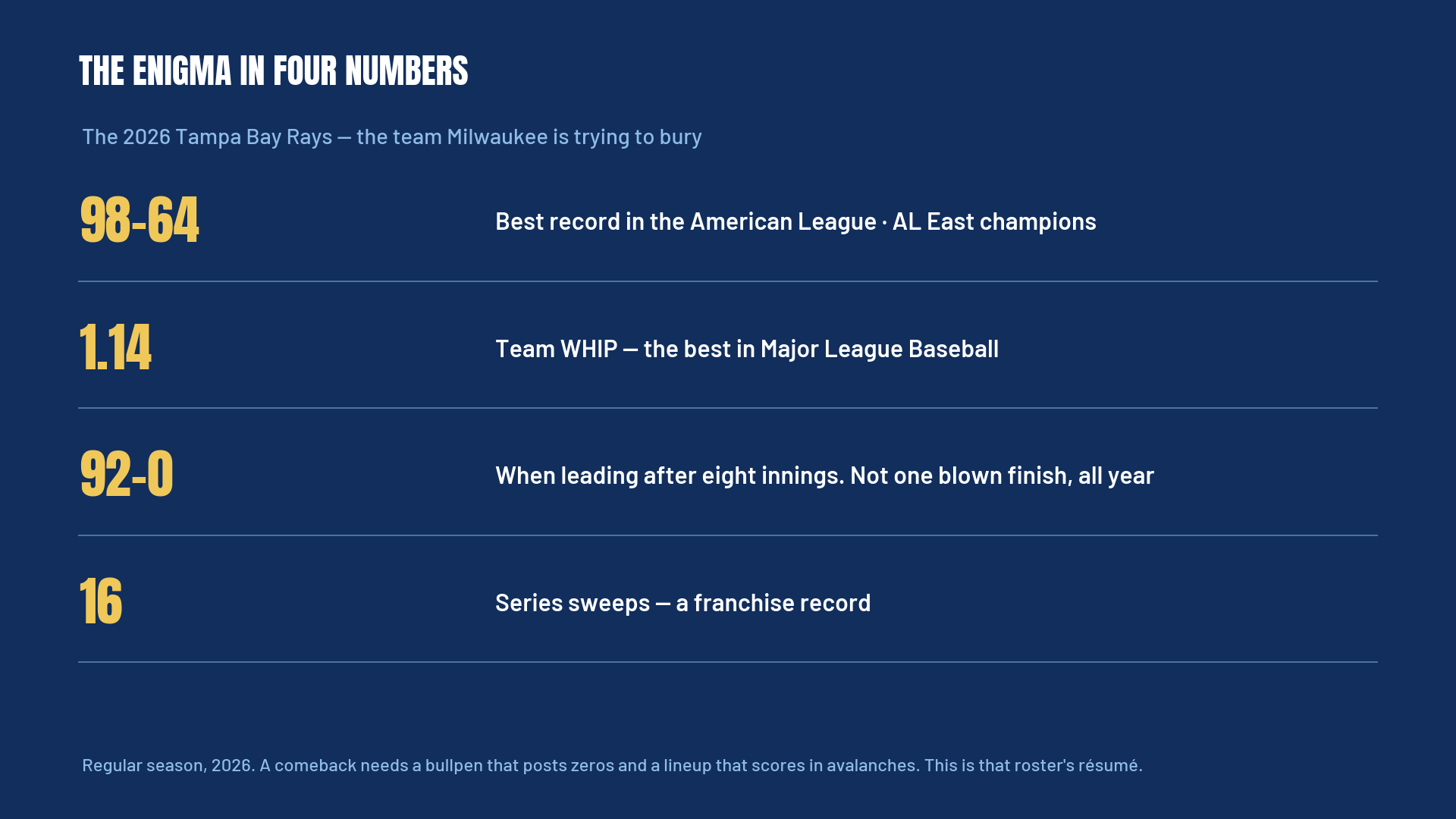
Tampa Bay, down 0–3 and outscored 18–7, a margin that should feel like 40, walks into Game 4 tonight with all three. That is not optimism. That is the roster.
The canon
Because if you are going to ask a city to believe something that has never happened, you had better show your work.
Start in 1975, on ice. The New York Islanders, a three-year-old franchise, lost the first three games of their quarterfinal to Pittsburgh — and then won four straight, the last of them 1–0 on a single third-period goal from their captain, Ed Westfall. The Islanders did not become a dynasty that spring. They became a proof of concept: a series is not over when the math says it should be. It is over when somebody wins a fourth game.
Baseball's copy of that proof arrived on an October night in 2004, and it arrived by inches. Boston, down 0–3 to the Yankees, down a run in the ninth in Game 4, Mariano Rivera on the mound — the greatest closer who ever lived, holding the shovel. Kevin Millar walked. Dave Roberts came in to run, and everyone in Fenway Park, Rivera included, knew he was going. He went on the first pitch. The throw was nearly perfect. The hand got there first. Bill Mueller singled him home, David Ortiz won it in the twelfth, and Boston won again in fourteen innings the next night, and then kept winning until an 86-year curse was a trivia answer. The Red Sox are still the only baseball team ever to survive 0–3 — and notice what started it. Not a slugfest. A walk, a steal, a single. One small crack of light.
The hockey teams kept filing sequels. Philadelphia, 2010: down 0–3 to Boston, the Flyers won three straight — and then, in Game 7, in Boston, went down 0–3 in the game itself, and won that too, Simon Gagné finishing a comeback inside a comeback. Los Angeles, 2014: down 0–3 to San Jose, the Kings took four straight and did not stop until they were carrying the Stanley Cup. And the single games are louder still. Istanbul, 2005: Liverpool, 0–3 at halftime to a Milan team that scored 40 seconds in, leveled a Champions League final in six minutes — Gerrard, Šmicer, Alonso — and won it on penalties behind a goalkeeper dancing on his line. Houston, February 2017: Atlanta led New England 28–3 deep into the third quarter of the Super Bowl, and Tom Brady threw for a Super Bowl–record 466 yards, scored 31 unanswered points, and won the first overtime game in the title's history. Cleveland, 2016: down 3–1 to a 73–9 team, the best regular-season team ever assembled, the Cavaliers won twice on the road and a Game 7 that turned on two plays in the last two minutes — LeBron James running down Andre Iguodala at the rim, Kyrie Irving hitting the shot over Stephen Curry, 93–89, and a 52-year drought ending in somebody else's building. Barcelona, a month after Brady: beaten 4–0 in Paris, they stood at the 88th minute of the return leg still needing three goals — and scored all three, Sergi Roberto stabbing home the sixth in the 95th minute, 6–1, the Camp Nou shaking like a kettle about to blow.
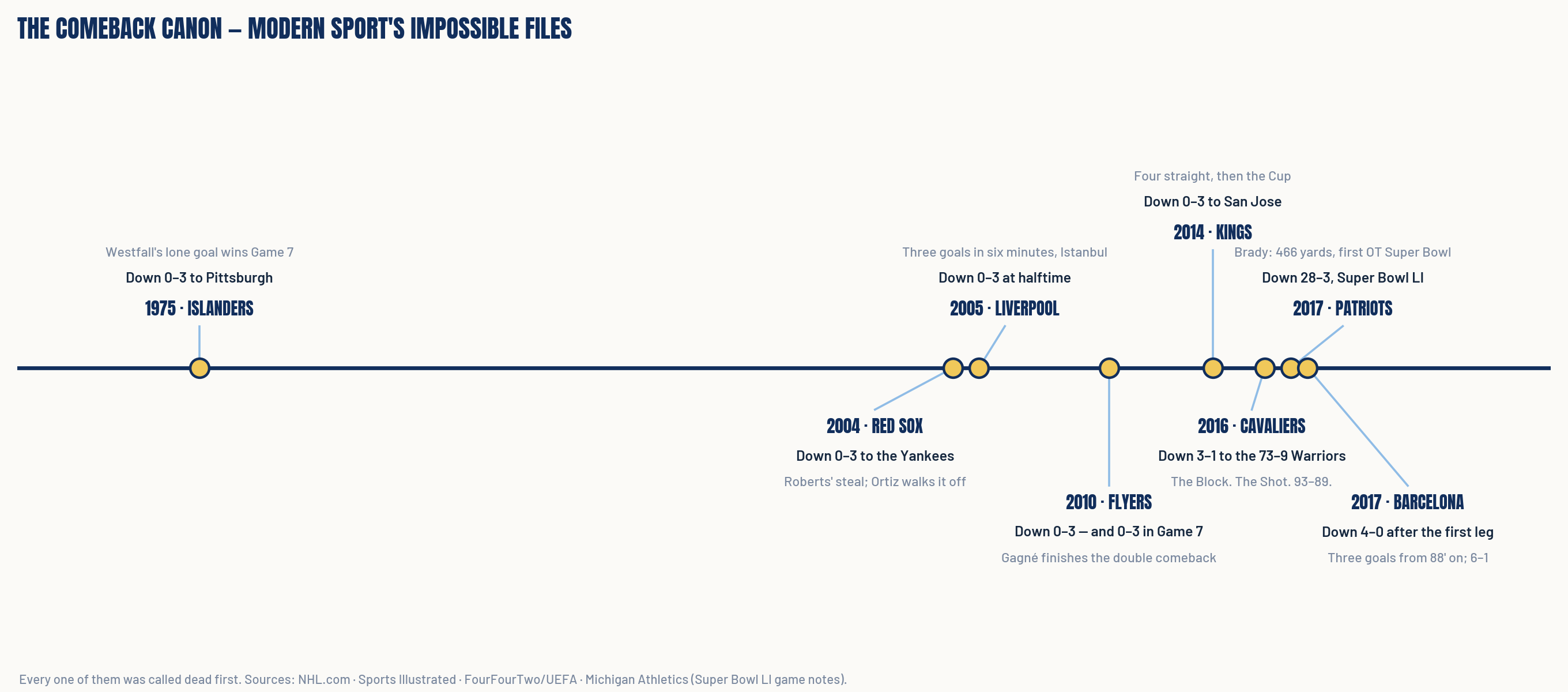
Read the file straight through and the lesson is not that miracles happen. It is that comebacks are built — out of a defense that suddenly posts zeros, an offense that scores in avalanches instead of drips, and one pivot moment that moves the fear from one dugout to the other. Which brings us back to the enigma in the home whites tonight.
Requirement one: make them stop scoring
A team that comes back from 0–3 does not out-slug its way home; it turns four straight games into fistfights. This is, by the numbers, the thing the 2026 Rays do better than anyone alive. Their staff WHIP this season was 1.14 — the best in Major League Baseball. They went 92–0 when leading after eight innings. Not 92–2, not a blown save here and a bad week there. Ninety-two times they carried a lead into the ninth, and ninety-two times they went home winners. That is not a bullpen stat. That is a personality.
Has the pitching been that team in this Series? No — and this is where the case has to stay honest or it is worth nothing. Peralta, facing the club that raised him, gave Game 3's fifth inning back. The staff that smothered the Yankees in a Division Series sweep and outlasted Cleveland in six has allowed 18 runs in three games. But the bones are the bones: this is the same run-prevention machine that won 98 games and the American League's best record, the same machine that clinched the AL East at Yankee Stadium in September. Machines like that do not forget how they work in a week. They have a bad inning. Sometimes, God help them, they have it on national television. The question tonight — Griffin Jax gets the ball first — is whether Tuesday gets the machine back.
Requirement two: score in avalanches
Here is the strangest true sentence of this World Series: the Rays have scored four runs in one inning and three runs in the other twenty-six. The avalanche is not a hope. It is a documented event — the first inning of Game 2, when Liam Hicks turned on a Logan Henderson pitch for a two-run homer and Tampa Bay hung four on Milwaukee before the Brewers knew the game had started. And then? Nothing. Zero runs over the final eight innings of Game 2. One run in the last seventeen innings of the Series. Seven total in three games.
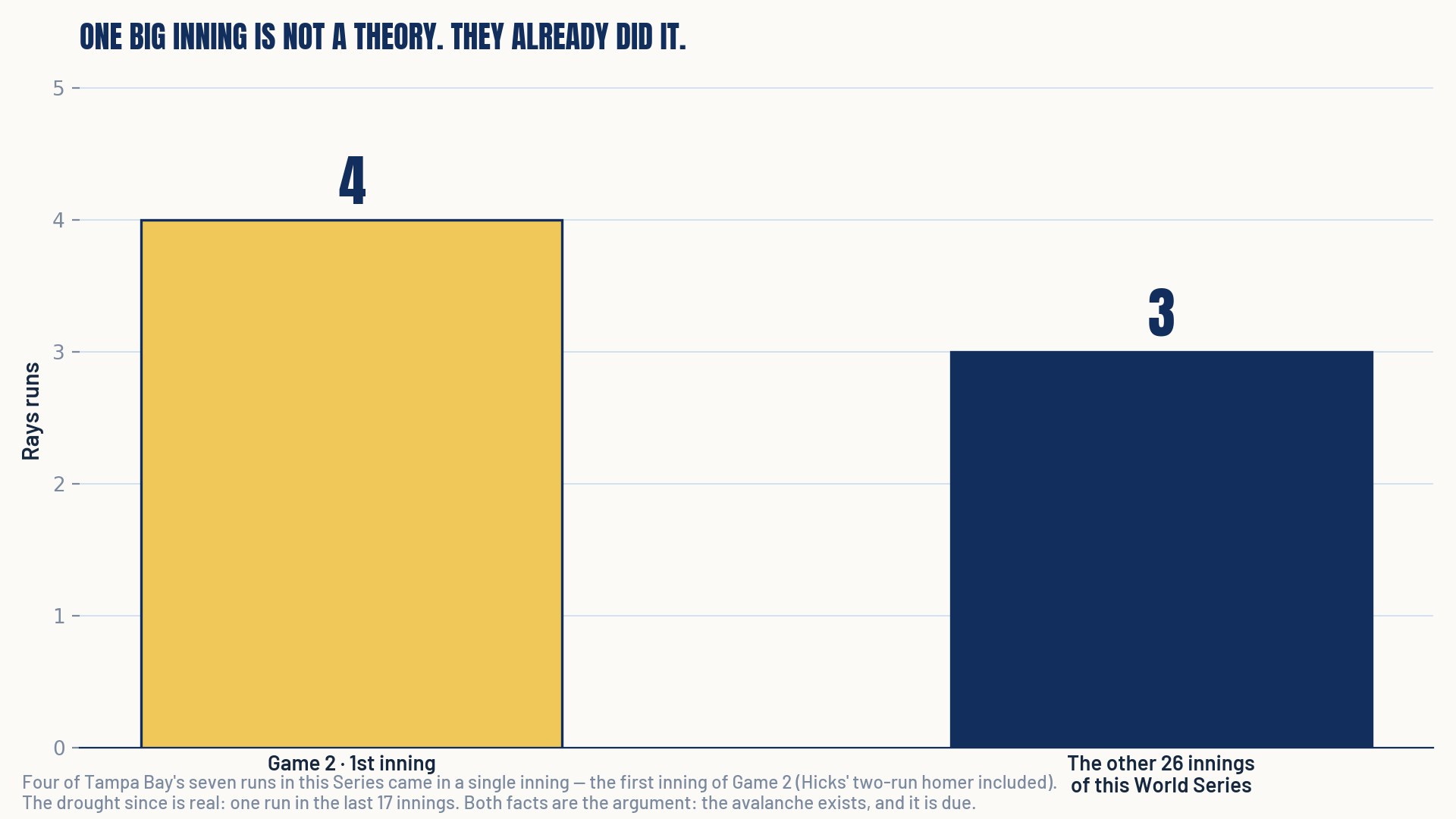
That split personality is precisely who this team has been all year, and it is why they are an enigma instead of a footnote. Sixteen times this season — a franchise record — the Rays swept a series, because when this lineup goes, it goes all at once and does not stop for three days. Junior Caminero hit 42 home runs and drove in 101 runs this year, and he is the kind of hitter — I have watched every game of it — who turns one inning into a weather event. The drought says Tampa Bay is finished. The record says Tampa Bay is a team whose offense arrives like a Florida thunderstorm: nothing, nothing, nothing, and then the sky opens. Milwaukee's bullpen has been the best unit in this Series, six scoreless innings of it in Game 2 alone. It is also, now, a bullpen that has to be perfect four more times.
Requirement three: the man in charge
Every entry in the canon has a calm head at the center of the storm. Tampa Bay's is a hometown kid who has managed this team since 2015 — the longest-tenured manager in the major leagues — who won the American League Manager of the Year award in 2020 and again in 2021, the only man in his league ever to win it back-to-back, and who passed Joe Maddon as the winningest manager in franchise history. Kevin Cash has managed this roster through everything the modern game can invent, including an entire season played out of a borrowed spring-training ballpark after a hurricane tore the roof off this one, and he brought them back under the dome this year, under new owners, and won 98 games and a pennant. He is the manager who helped invent the opener, who treats a pitching staff like a chess clock, who defended his 23-year-old third baseman in the wreckage of the worst inning in franchise history and then said chip and a chair like a man dealing himself in.
If the Rays get one big inning — one — and get their pitching back right behind it, they are the team that can pull off this upset. I believe that the way you believe a weather forecast in October in Florida: the conditions are read off instruments, not wishes. The instruments say the run prevention is championship grade. They say the avalanche exists and is overdue. They say the manager has the steadiest hand in the sport. And they say Milwaukee — 103 wins, 10–1 this October, eight straight victories, the best team in baseball — has to finish the job against the one roster in the sport built exactly like the ones in the file.
One more thing about that file. Every team in it was buried by its own fifth inning first — by a 19–8 humiliation, a 0–3 hole in a Game 7, a 28–3 scoreboard, a first leg that ended 4–0. The grave is part of the story. It is never the whole story. The whole story is four games long, and it starts with one inning, and the inning starts tonight, under a roof in St. Petersburg, with the Gulf heat pressing on the doors and a city that has decided — against the math, against the obituaries, against twenty-five-for-twenty-five — to keep its chair at the table.
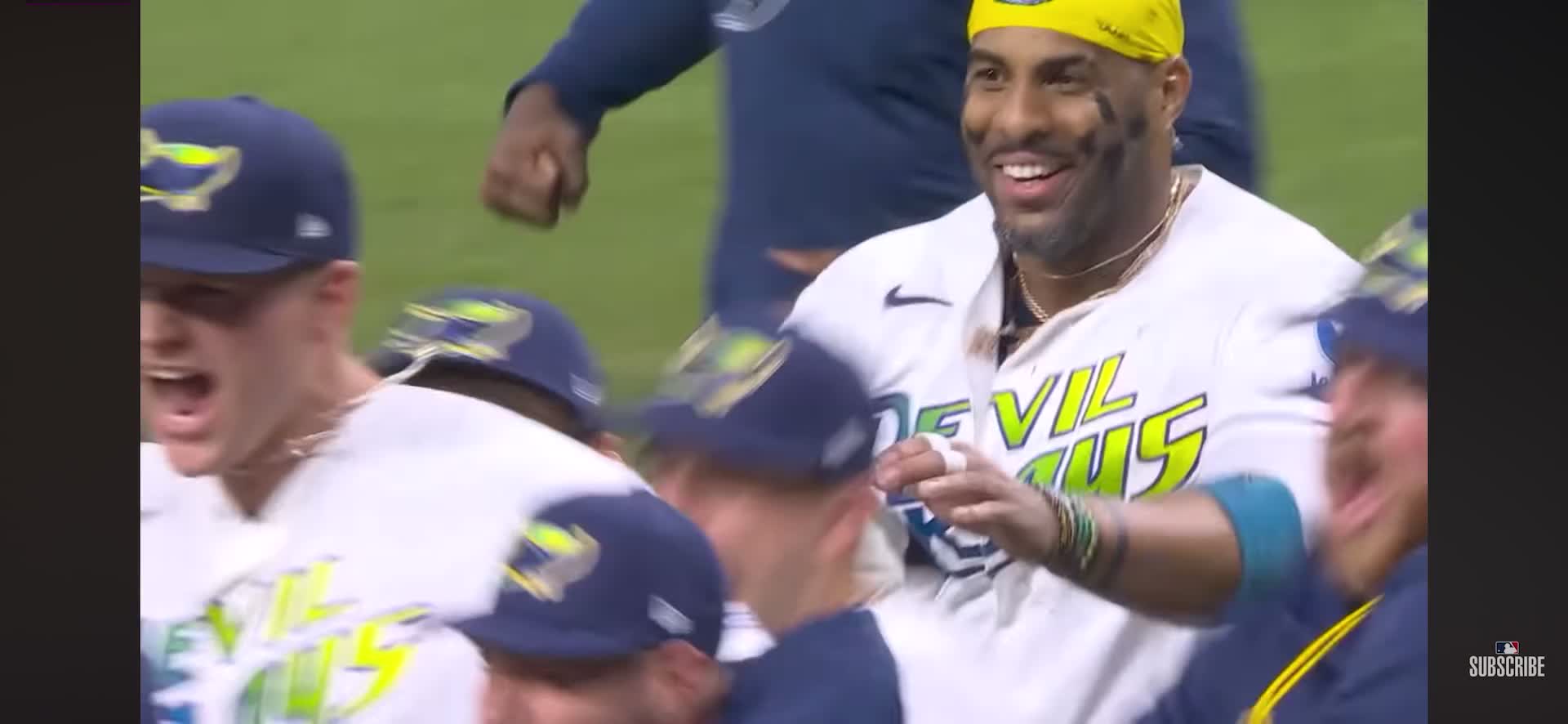
Win one. Then talk.
Sources
Series and Game 3 reporting: Elias Sports Bureau (eight two-out runs in one World Series inning, a first) via game coverage, Oct. 26–27, 2026 · USA Today, Game 3 error sequence report, Oct. 27, 2026 · Associated Press via BusinessMirror, Oct. 27, 2026 · 25-for-25 stat and 0-for-43 best-of-seven history: Elias/AP. Rays season figures (98–64, 1.14 WHIP, 92–0 when leading after eight, 16 sweeps, Caminero 42 HR / 101 RBI): Front Office Blueprint's verified season records. Kevin Cash managerial history: Sports Illustrated / Fastball (franchise wins record, May 2024) and BBWAA award records (AL Manager of the Year 2020, 2021). Comeback canon: NHL.com (1975 Islanders; Stanley Cup champions history) · The Hockey News · NBC Sports Boston and BaseballHistory.org (2004 Red Sox) · FourFourTwo and Football Italia (Istanbul 2005) · Super Bowl LI game records (Brady 466 yards; first Super Bowl overtime) · Sports Illustrated and HoopsHabit (2016 NBA Finals) · DAZN (La Remontada, Mar. 8, 2017).
Cash Emerson Roper has kept a written report on every Tampa Bay Rays game this season — 173 of them through Game 2 of this World Series — and hosts Front Office Blueprint, a daily sports-business show. He is a former catcher, catching coach, and hitting coach.